

What is Marine Cable?
Summary
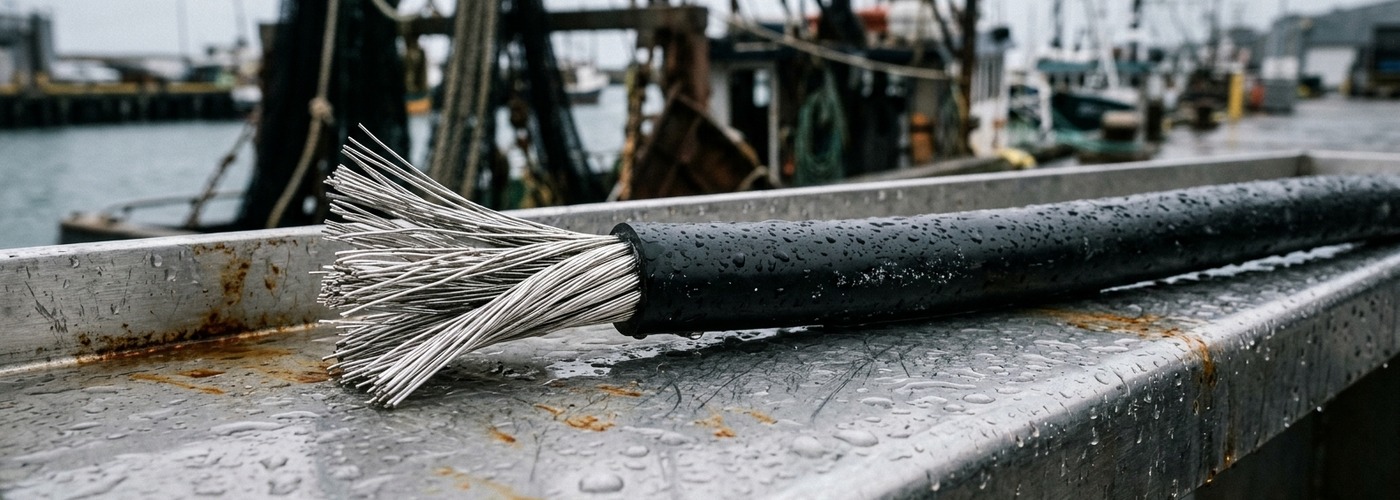
Marine cable is electrical wire built for boats and other wet, high-vibration environments. Marine grade wire typically uses tinned copper conductors, fine stranding, and insulation that resists moisture, oil, and fuel. Boat cable is the term for cable listed to UL 1426, covering both single-conductor primary wire and jacketed duplex and triplex cable.
This guide compares marine wire vs. regular wire, explains why SAE-sized automotive wire can carry less copper at the same nominal gauge, and outlines what to specify when sourcing wet-environment cable for marine, military, and heavy equipment applications.
Marine cable is electrical wire built for boats and other wet, high-vibration environments, using tinned copper conductors, fine stranding, and moisture- and oil-resistant insulation to resist corrosion and fatigue. In North America, marine-grade boat cable is commonly identified by a UL 1426 listing, the standard for electrical cables for boats. Compared with standard building or automotive wire, marine wire is more flexible, better protected against oxidation, and sized to full AWG cross-sections.
This guide covers what marine grade wire is, how marine wire compares with regular wire, what boat cable means, and how the same design principles carry over to military and heavy equipment cabling. Marine cable is one of several types of electrical cable, each suited to a different operating environment.
On This Page
What is Marine Grade Wire?
Marine grade wire is wire whose conductor, stranding, and insulation are designed for continuous exposure to moisture, salt, fuel, oil, and vibration. The term describes how the wire is built, not only where it is used. Three traits typically define it:
- Tinned copper conductors: Each strand is typically coated with tin, which slows the oxidation that discolors bare copper and raises its resistance in humid, salty air. Tinned oxygen-free copper (TOFC) is a common form.
- Fine stranding: Marine wire uses a high count of small strands, often described as Type III or Class K stranding. This improves flexibility and resistance to fatigue from engine and hull vibration.
- Durable insulation: Jackets are formulated to resist moisture, oil, fuel, and abrasion, and are typically marked with separate temperature ratings for dry and wet conditions.
Marine grade wire listed to UL 1426 is typically printed with that standard or with the BC-5W2 designation along the jacket, which gives installers and inspectors a quick way to confirm what is installed.
Marine Wire vs. Regular Wire
The main differences between marine wire and regular wire are conductor plating, strand count, sizing standard, and insulation durability. The table below compares marine wire with typical building and automotive wire.
| Attribute | Marine Wire | Regular Wire (Building or Automotive) |
|---|---|---|
| Conductor | Tinned copper that resists oxidation | Typically bare copper that oxidizes in damp or salty conditions |
| Stranding | Fine, high strand count for maximum flexibility | Solid or coarser stranding, less tolerant of repeated flexing |
| Sizing Standard | Sized to full AWG cross-sections | Building wire is AWG-sized; automotive primary wire is often SAE-sized and can carry less copper at the same nominal gauge |
| Insulation | Formulated for moisture, oil, fuel, and abrasion, with dry and wet temperature ratings | Varies by type; often not intended for continuous wet, oily, or vibrating environments |
| Vibration Tolerance | High | Lower; solid conductors can work-harden and crack |
| Cost | Higher per foot | Lower per foot |
| Best Fit | Boats, docks, washdown areas, and other wet, high-vibration installations | Dry, stationary installations |
Why marine wire carries more copper at the same gauge: Marine wire is sized to AWG, while automotive primary wire is often sized to SAE. SAE wire can be up to about 12% smaller in cross-section than AWG wire of the same nominal gauge, so it has more resistance per foot and carries less current. This sizing gap is the source of the common claim that marine wire is thicker.
The higher upfront cost of marine wire is usually justified by service life. Once bare copper corrodes, resistance rises, which leads to heat, voltage drop, and intermittent faults that are difficult to trace inside a hull or harness. Replacing failed wiring typically costs more in labor and downtime than specifying the right wire at the start.
What is Boat Cable?
Boat cable is the term UL uses for cable listed to UL 1426, Electrical Cables for Boats. It covers single-conductor primary wire as well as jacketed multi-conductor cable, such as duplex (two-conductor) and triplex (three-conductor) cable. Listed boat cable is commonly marked BC-5W2 on the jacket.
In the U.S., ABYC E-11 provides voluntary recommendations for AC and DC electrical systems on boats. U.S. Coast Guard regulations in 33 CFR Part 183, Subpart I, set electrical system requirements for boats with gasoline engines other than outboards. Boat builders and marine electricians typically reference these alongside UL 1426 when selecting and installing cable.
Common Types of Marine Electrical Cable
- Primary wire: Single-conductor wire for DC circuits such as lighting, pumps, and accessories.
- Duplex and triplex cable: Two- or three-conductor jacketed cable for DC pairs or AC circuits, available in flat and round versions.
- Battery cable: Large-gauge, highly flexible cable for battery banks, starters, and other high-current loads.
- Shielded and data cable: Cable for electronics and networks where electrical interference needs to be controlled.
Marine-Grade Principles in Military and Heavy Equipment
The conditions marine cable is designed for are not unique to boats. Military vehicles, heavy equipment, and earth moving equipment expose wiring to many of the same stressors: water and mud, washdown, road salt, fuel and hydraulic fluid, and constant vibration. Cabling in these applications relies on the same design priorities: corrosion-resistant conductors, flexible stranding, durable jackets, and sealed terminations.
Terminations matter as much as the wire. A corrosion-resistant cable can still fail at an unsealed ring terminal or connector, so assemblies for wet environments commonly use adhesive-lined heat shrink and sealed fuse holders at each end. Gateway Cable Company’s in-line fuse assemblies, battery and starter cables follow this approach, with ring-to-ring construction, adhesive-lined heat shrink, and waterproof fuse holders on select assemblies.
What to Specify When Sourcing Wet-Environment Cable
Including these details in a quote request shortens turnaround and reduces back-and-forth:
- Conductor material and plating, such as bare or tinned copper
- Gauge and sizing standard, AWG or SAE
- Stranding or flexibility requirement
- Voltage and temperature ratings, including wet-condition ratings
- Jacket resistance needs, such as oil, fuel, UV, or abrasion
- Required listings or specifications for the application
- Termination type and sealing method
- Lengths, labeling, and quantities
Source Cable Assemblies for Harsh Environments
Gateway Cable Company supplies power and electrical cable assemblies, connectors, and power distribution components for military, defense, and industrial applications. The company is ISO 9001:2015 certified and CMMC certified. Learn more about Gateway Cable Company, or email sales@tgccompany.com with your part requirements.
Marine Cable FAQs
What is marine cable?
Marine cable is electrical cable built for boats and other wet, high-vibration environments. It typically uses tinned copper conductors, fine stranding, and insulation that resists moisture, oil, fuel, and abrasion.
What is marine grade wire?
Marine grade wire is wire constructed for marine conditions, typically with tinned copper strands, a high strand count for flexibility, and durable insulation. In North America, it is commonly listed to UL 1426 and identified by markings printed on the jacket.
What is the difference between marine wire and regular wire?
Marine wire uses tinned, finely stranded copper and insulation designed for wet conditions, and it is sized to full AWG cross-sections. Regular wire is usually bare copper with coarser stranding, and SAE-sized automotive wire can carry less copper at the same nominal gauge.
What is boat cable?
Boat cable is cable listed to UL 1426, Electrical Cables for Boats. It includes single-conductor primary wire as well as jacketed duplex and triplex cable, and it is commonly marked BC-5W2 on the jacket.
Can you use regular wire on a boat?
Solid-core household wire should not be used on a boat because it can crack under vibration. SAE automotive wire is acceptable only in limited dry locations under ABYC guidance, since bare copper corrodes in damp, salty air and SAE sizing carries less copper. Marine grade wire is standard practice for boat wiring.
Is marine wire thicker than regular wire?
At the same nominal gauge, marine wire carries more copper than SAE-sized automotive wire because it is sized to AWG. SAE wire can be up to about 12% smaller in cross-section than AWG wire of the same gauge.