

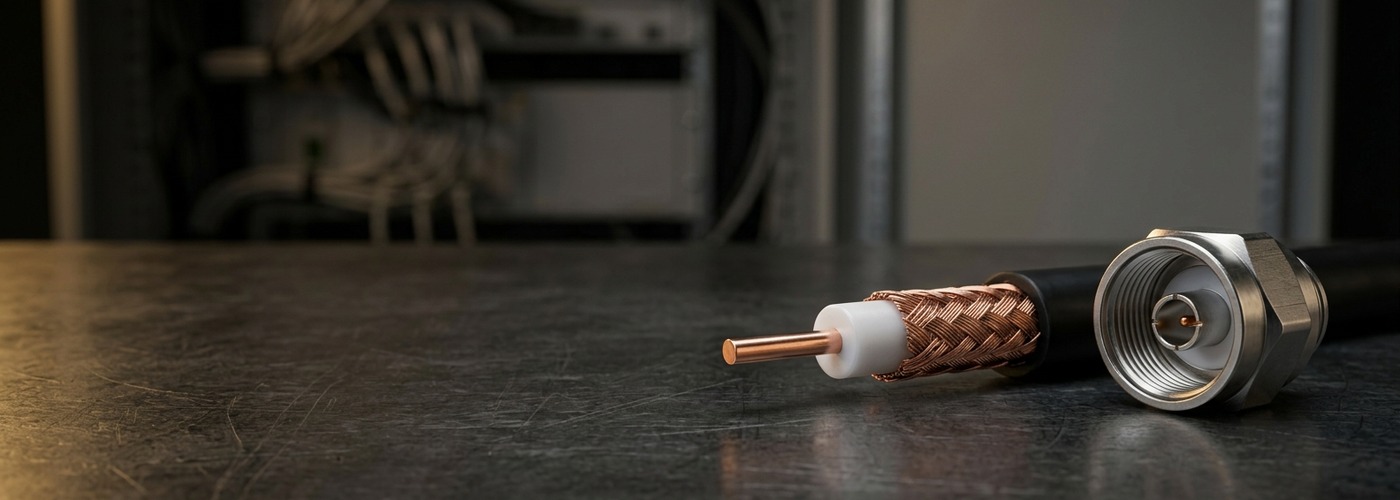
How to Terminate Coax Cable: Steps, Methods, and Connectors
Summary
Proper coax cable termination protects signal quality and prevents loss, interference, and intermittent connections. This guide walks through how to terminate coax cable step by step, from cutting and stripping to seating, compressing, and verifying the connector.
It compares common coaxial cable termination methods, including compression, crimp-on, twist-on, and solder. It also reviews coax connector types such as F-type, BNC, TNC, N-type, and SMA. Additional sections cover impedance matching, replacing damaged coax cable ends, and testing a finished termination for continuity and shorts.
To terminate a coax cable, cut the end square, strip the jacket, shield, and dielectric to the connector’s specified dimensions, fold the braided shield back, seat the connector, and secure it with a compression or crimp tool before testing the finished end. A clean termination keeps the center conductor centered, maintains full shield contact, and preserves the cable’s impedance, which protects signal quality. The right method depends on the connector type, the cable, and the environment the termination will operate in, from broadband and video systems to military and industrial RF communications.
On This Page
- What Does It Mean to Terminate a Coax Cable?
- Tools for Coax Cable Termination
- How to Terminate Coax Cable Step by Step
- How to Cut Coax Cable Without Damaging It
- Coax Termination Methods
- Coax Cable Ends and Connector Types
- Matching Cable and Connector Impedance
- How to Replace the End of a Coax Cable
- How to Test a Terminated Coax Cable
- Frequently Asked Questions
What Does It Mean to Terminate a Coax Cable?
Coax cable termination usually means attaching a connector to the end of a coaxial cable so it can connect to equipment, another cable, or a panel. A coaxial cable has four layers: a center conductor, a dielectric insulator, a shield (foil, braid, or both), and an outer jacket. A proper termination keeps each layer in its correct position so the signal travels through the connection with minimal loss or reflection.
The term can also refer to a coax terminator, an impedance-matched cap that closes off an unused port or cable end. Terminators absorb signal that would otherwise reflect back into the system, which is why unused ports on splitters, taps, and RF equipment are often capped rather than left open.
Tools for Coax Cable Termination
Before you begin, gather the following:
- Coax cable cutter: Cuts the cable cleanly without crushing it.
- Coax cable stripper: Sized for the specific cable type, so each layer is cut to the correct length.
- Connectors: Matched to the cable type, impedance, and termination method.
- Compression or crimp tool: Matched to the connector, with the correct die for crimp-style connectors.
- Multimeter: For continuity and short testing after termination.
- Needle-nose pliers (optional): For removing cut material and straightening the center conductor.
How to Terminate Coax Cable Step by Step
The steps below cover a standard compression or crimp termination. Always follow the strip dimensions and instructions provided for the specific connector.
- Cut the cable end square with a coax cable cutter so the cable stays round.
- Insert the cable into a coax stripper sized for that cable and rotate it until the blades cut through the jacket and dielectric to the specified lengths.
- Remove the cut sections of jacket and dielectric, exposing the center conductor and the shield.
- Fold the braided shield back evenly over the jacket, leaving any foil in place around the dielectric.
- Inspect the end and remove any stray braid strands. A single strand touching the center conductor will short the connection.
- Push the connector onto the cable until the dielectric sits flush with the connector’s inner post and the center conductor extends to the correct length.
- Secure the connector with the compression tool or crimp tool until it is fully seated.
- Pull gently on the connector to confirm it is secure, then test the finished cable.
Many F-type compression connectors use a 1/4 in. exposed center conductor and 1/4 in. exposed dielectric. Other connector types use different dimensions, and some require a crimped or soldered center pin, so confirm the specification before stripping.
How to Cut Coax Cable Without Damaging It
Cutting is the first step in any coaxial cable termination, and a poor cut can ruin the connection before the connector goes on. Standard side cutters tend to flatten the cable, which shifts the center conductor off center and distorts the dielectric. A dedicated coax cutter with curved blades cuts cleanly through all layers while keeping the cable round.
Cut the cable squarely across its diameter, not at an angle. After cutting, check that the center conductor is straight and centered in the dielectric. If the end is crushed or uneven, cut it again a short distance back before stripping.
Coax Termination Methods
Coaxial cable terminations use one of four main attachment methods. Each one suits different connector types and operating conditions.
| Method | How It Works | Best Suited To | Tool Required |
|---|---|---|---|
| Compression | A sleeve is pressed axially into the connector body, forming a secure 360-degree grip on the cable | Permanent, moisture-resistant terminations, including most F-type connections | Compression tool |
| Crimp-on | A metal ferrule is crimped over the shield, and the center pin is crimped or soldered on some connectors | BNC, TNC, and N-type RF connections | Ratcheting crimp tool with the correct die |
| Twist-on | The connector threads directly onto the cable jacket | Temporary or low-demand indoor connections | None |
| Solder | The center pin is soldered, and the connector body is clamped or crimped to the shield | Certain N-type and precision RF connectors | Soldering iron and clamp or crimp tools |
Twist-on connectors are the only option that requires no crimping tool, but they grip less securely and are more likely to loosen or admit moisture. For outdoor use, vibration, or higher-frequency RF systems, compression and crimp terminations are the more reliable choice.
Coax Cable Ends and Connector Types
The connector on a coax cable end must match the cable, the equipment interface, and the system’s impedance. Common coaxial connector types include:
| Connector | Impedance | Coupling | Common Applications |
|---|---|---|---|
| F-type | 75 ohm | Threaded | Video, broadband, and satellite systems |
| BNC | 50 ohm and 75 ohm versions | Bayonet quick-connect | Test equipment, video, and RF communications |
| TNC | 50 ohm | Threaded | RF connections exposed to vibration |
| N-type | 50 ohm (75 ohm versions exist) | Threaded | Outdoor and higher-power RF, antennas, and military and industrial communications |
| SMA | 50 ohm | Threaded, compact | Microwave, GPS, and compact RF devices |
For a broader overview of connector families, see our guide to electrical connector types. For connector and cable assembly requirements beyond standard coax ends, Gateway Cable Company manufactures military and industrial connectors, receptacles, and adaptors.
Matching Cable and Connector Impedance
Coaxial cable is built to a specific characteristic impedance, most commonly 50 ohm or 75 ohm. The connector must match the cable’s impedance. A mismatch causes part of the signal to reflect back toward the source, increasing signal loss and reducing performance.
- 75 ohm cable is typically used for video, broadband, and satellite signals.
- 50 ohm cable is typically used for RF communications, radio, antennas, and test equipment.
Coax cables are often identified by RG designations, a naming system that originated with U.S. military coaxial cable specifications. Common examples include RG-6 and RG-59 (75 ohm) and RG-58 (50 ohm). For more on how coax compares to other cable constructions, see our overview of electrical cable types.
How to Replace the End of a Coax Cable
A damaged, loose, or corroded coax cable end can be replaced without replacing the full cable, provided there is enough length to work with.
- Disconnect the cable from equipment and power down any connected devices.
- Cut off the old connector, removing enough cable to reach clean, undamaged material.
- Inspect the new cable end for corrosion, moisture, or a discolored shield. Cut further back if needed.
- Terminate the new end using the step-by-step process above and a connector matched to the cable.
- Test the cable before returning it to service.
Compression and crimp connectors are generally not reusable once installed. Twist-on connectors can sometimes be removed by unthreading them, but reusing them is not recommended for critical connections.
How to Test a Terminated Coax Cable
A multimeter confirms that a new termination is complete and free of shorts. Disconnect the cable from all equipment before testing, and remove any terminator from the far end.
- Set the multimeter to continuity or resistance.
- Test from the center conductor at one end to the center conductor at the other. The meter should show continuity.
- Test from the shield or connector body at one end to the shield at the other. The meter should also show continuity.
- Test between the center conductor and the shield at the same end. The meter should show an open circuit. Continuity here indicates a short, usually caused by a stray braid strand.
A multimeter confirms continuity and shorts but not signal quality at operating frequency. Critical RF systems may require additional testing with dedicated equipment. For more detail, see our guides on how to test cables with a multimeter and how a multimeter works.
Request a Quote for Custom Cable Assemblies
Gateway Cable Company is an ISO 9001:2015 and CMMC certified manufacturer of connectors, receptacles, and cable assemblies for military, defense, and industrial applications. Share your part number, drawing, or specifications to start a quote. To discuss your application, contact our team, or browse our product categories to review related components.
Frequently Asked Questions
How do you terminate a coaxial cable?
Cut the cable square, strip the jacket and dielectric to the connector’s specified dimensions, fold back the braided shield, remove stray strands, seat the connector, and secure it with a compression or crimp tool. Test the finished cable for continuity and shorts before use.
How do you cut coax cable?
Use a dedicated coax cable cutter and cut squarely across the cable. Standard side cutters can crush the cable and push the center conductor off center, which affects the termination.
What type of connector is used to terminate a coaxial cable?
Common coaxial connectors include F-type, BNC, TNC, N-type, and SMA. The correct connector depends on the cable type, impedance, equipment interface, and operating environment.
How do you terminate coax cable without a crimping tool?
Twist-on connectors thread directly onto the cable and require no crimping tool. They grip less securely than compression or crimp connectors, so they are best suited to temporary or low-demand indoor connections.
What is the difference between 50 ohm and 75 ohm coax?
75 ohm coax is typically used for video, broadband, and satellite signals, while 50 ohm coax is typically used for RF communications, radio, antennas, and test equipment. The connector must match the cable’s impedance.
What is a coax terminator?
A coax terminator is an impedance-matched cap that closes off an unused port or cable end. It absorbs signal that would otherwise reflect back into the system.